
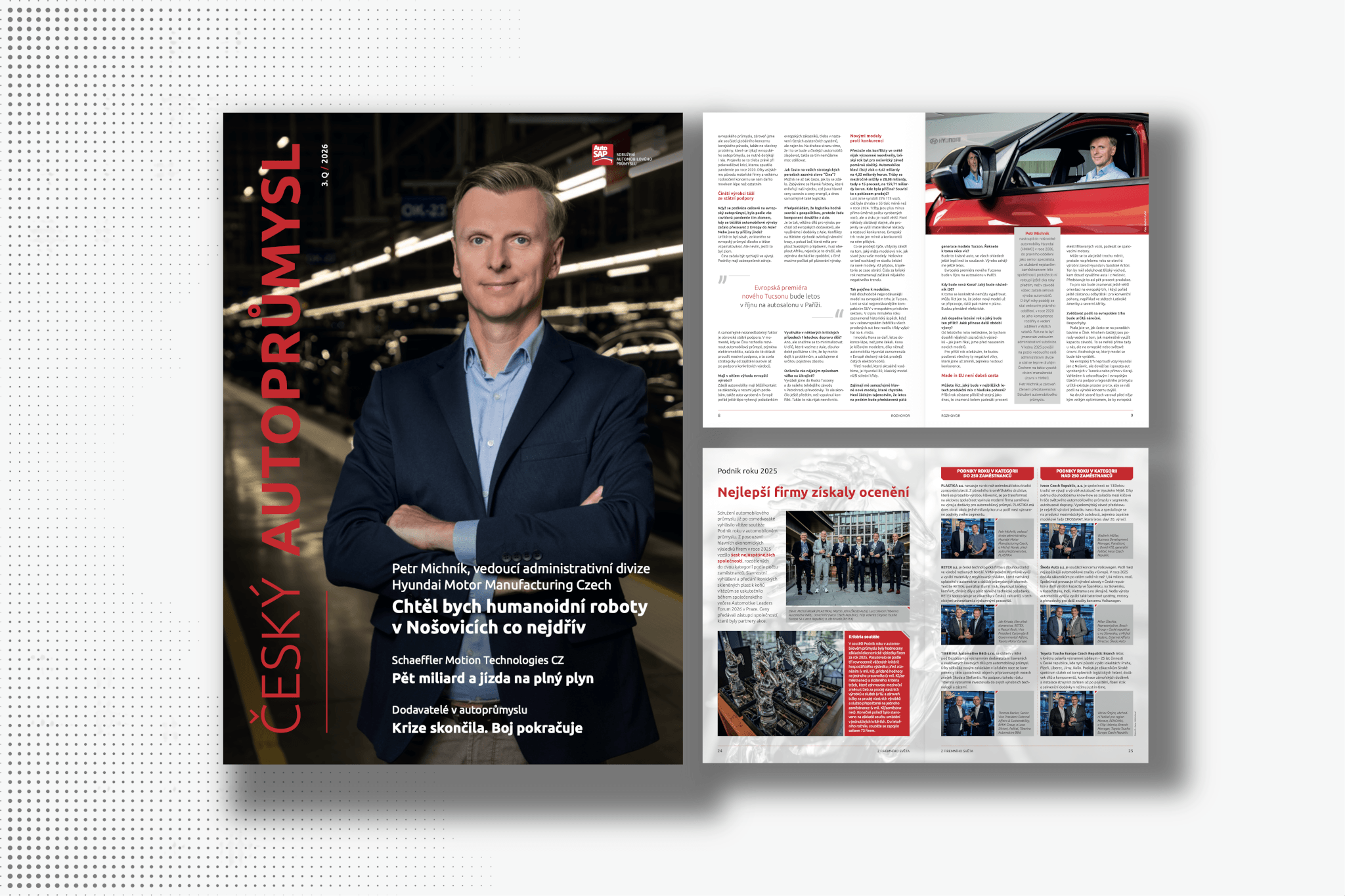
Winter edition of the Czech Automotive Industry magazine

12/12/2025 |Articles are machine translated

A fairly comprehensive picture of the state of the automotive sector could be drawn from the headlines of the articles in this issue of the magazine alone. If you want to start with the overall situation and an attempt to find answers to questions about how to keep Central and Eastern Europe attractive for business in times of energy uncertainty, regulatory pressures and geopolitical changes, then scroll straight to the report from the eighth annual CEE Automotive Supply Chain conference in Olomouc, “Transformation without uncertainties: How to keep Europe in the global game?”. Add to this the European framing, which you can find under the headlines “Problems are known, solutions are coming slowly”, or “The European Union is catching up”. And thirdly, the current situation is illustrated by a large open interview with Professor Vladimír Mařík, scientific director of the Czech Institute of Informatics, Robotics and Cybernetics, “The Czech Republic has the potential to be a technological superpower. All that is missing is courage and vision”.


But this is only one view, the less cheerful one. The reality is that many companies lack vision and courage. “Tatra is facing the biggest modernization in history. The machines and the way of working will change,” says Kristijan Fiket, CEO of TATRA TRUCKS, in another major interview. The old-new boss of the Kopřivnice company has a plan to increase production capacity to more than 3,000 cars per year by 2028. AGADOS also has a plan (“Preparing for the future. According to the action plan”), Toyota in Kolín (“The Japanese are betting on the Czech Republic”), let alone Škoda Auto (“Nine months of growth”).

As CzechInvest representatives say, investors are still interested in the Czech Republic, as evidenced by the recently announced investment by AISIN (“From a component supplier to a small car manufacturer”). Although, some investors complain that they are waiting a long time for a decision whether the state will support them with an incentive (“Incentives are waiting for clear rules, investors for quick decisions”). Karel Havlíček, the likely future Minister of Industry and Trade, says: “Investments yes, but not at any price.” His economic strategy is based on an overall improvement of the business environment. So we will see. Whether the Hungarian “Automobile Miracle on the Danube” can be an inspiration, I leave to the readers’ judgment. So it is not as bad as it may sometimes seem. Here are other examples: In RETEX “Unique device turns waste into high-tech insulation”, VŠB-TUO can boast of having received the “Prestigious award for research for the autinno society” in the field of autonomous systems and onsemi cooperates with schools because it knows “How to arouse interest in technology”.

Even the above-mentioned interview with Professor Mařík about the slow introduction of smart solutions into Czech companies is not a lament over the current state of affairs, but rather a call for change. Which may not be easy – if only because in some companies old systems resist technological innovations. But it is nothing that should be surprising. Carlos Davidovich, an expert in neuromanagement, says: “Resistance to change is not a weakness, but a natural function of the brain.” In his text, he explains how to respond to signals, turn fear into concentration, hesitation into learning, and resistance into movement. So let it go.

Have a wonderful and peaceful Christmas.


to read

HERE

Contact

Ing. Tomáš Jungwirth

Communications Manager

jungwirth@autosap.cz
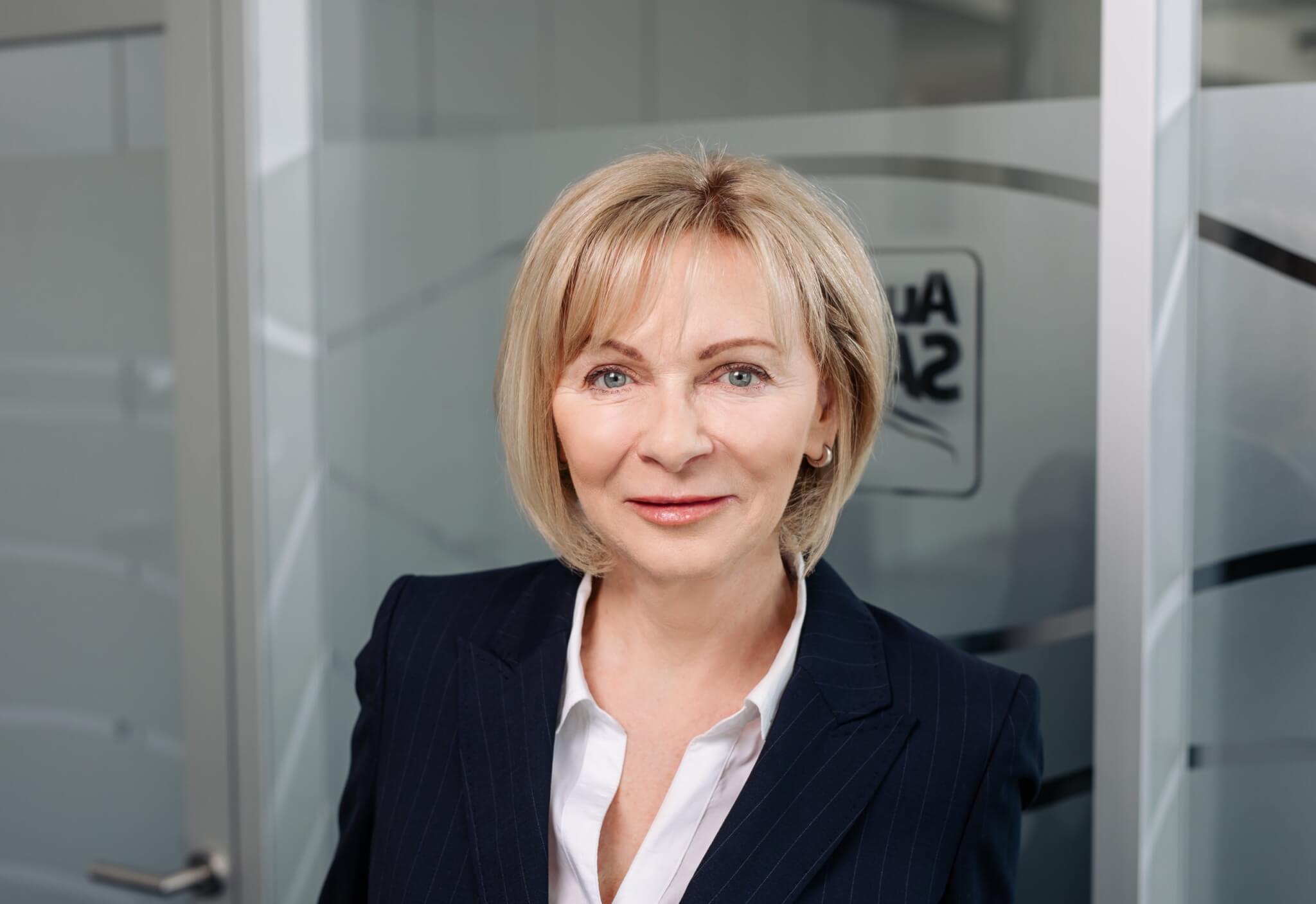
Ing. Libuše Bautzová

Editor-in-Chief of the Český autoprůmysl magazine

bautzova@autosap.cz

Next news

Next news

+ Show