The United States remains one of the world’s largest and most important automotive markets. Beneath the surface of relatively stable sales numbers, however, the American automotive landscape is changing rapidly. Production is shifting to new regions, tariffs are affecting investment decisions, electromobility is giving way to a more realistic powertrain mix, and software, electronics and access to data are increasingly determining the future value of a car.
When you think of the American auto industry, most people think of Detroit, Ford and General Motors. However, the current form of the industry is much more diverse. The United States remains the world’s second largest automobile market after China, while also being one of the largest importers of automobiles and increasingly becoming a production base for foreign automakers. Today, American automotive represents a large industrial ecosystem that fundamentally influences trade policy, energy, employment and technological development of the country.
In the context of the current administration’s trade policies, the U.S. auto industry may seem contradictory at first glance. On the one hand, new factories are being built in the country, automakers are announcing investments worth tens of billions of dollars, and federal and state politics openly support the transfer of production to American soil. On the other hand, manufacturers face high costs, uncertain customs conditions, slower growth of electromobility and pressure to maintain the availability of vehicles for ordinary customers.
It is this contradiction that is the key to understanding current developments. The United States is not going through a simple return to traditional car manufacturing or a clear transition to electric cars. A new industrial model is emerging here, in which domestic production, North American supply chains, trade protection, technological competition and the increasingly powerful role of software are interconnected.
General Motors leads sales
In 2025, 16.2 million new light vehicles, i.e. passenger cars, pickup trucks and light commercial vehicles, were sold in the United States. This was a year-on-year increase of 2.4 percent and the best result since 2019, the last year before the Covid pandemic. Official statistics from the American National Automobile Dealers Association (NADA) confirm not only the total market volume, but also its gradual transformation, with sales of hybrid vehicles growing rapidly, while sales of pure electric vehicles slowed significantly after the end of federal tax support.
In 2025, General Motors remained the market leader overall with sales of 2.85 million vehicles. One in six new cars sold in the US belonged to one of its brands. Toyota came in second with 2.52 million vehicles and Ford 2.2 million.
Toyota’s position also illustrates the different development of American electromobility. Electrified models made up nearly half of its U.S. sales, but the vast majority were hybrids, not pure electric vehicles. Toyota is benefiting from a strategy that some in the market considered too cautious a few years ago but is now proving well-suited to local demand.
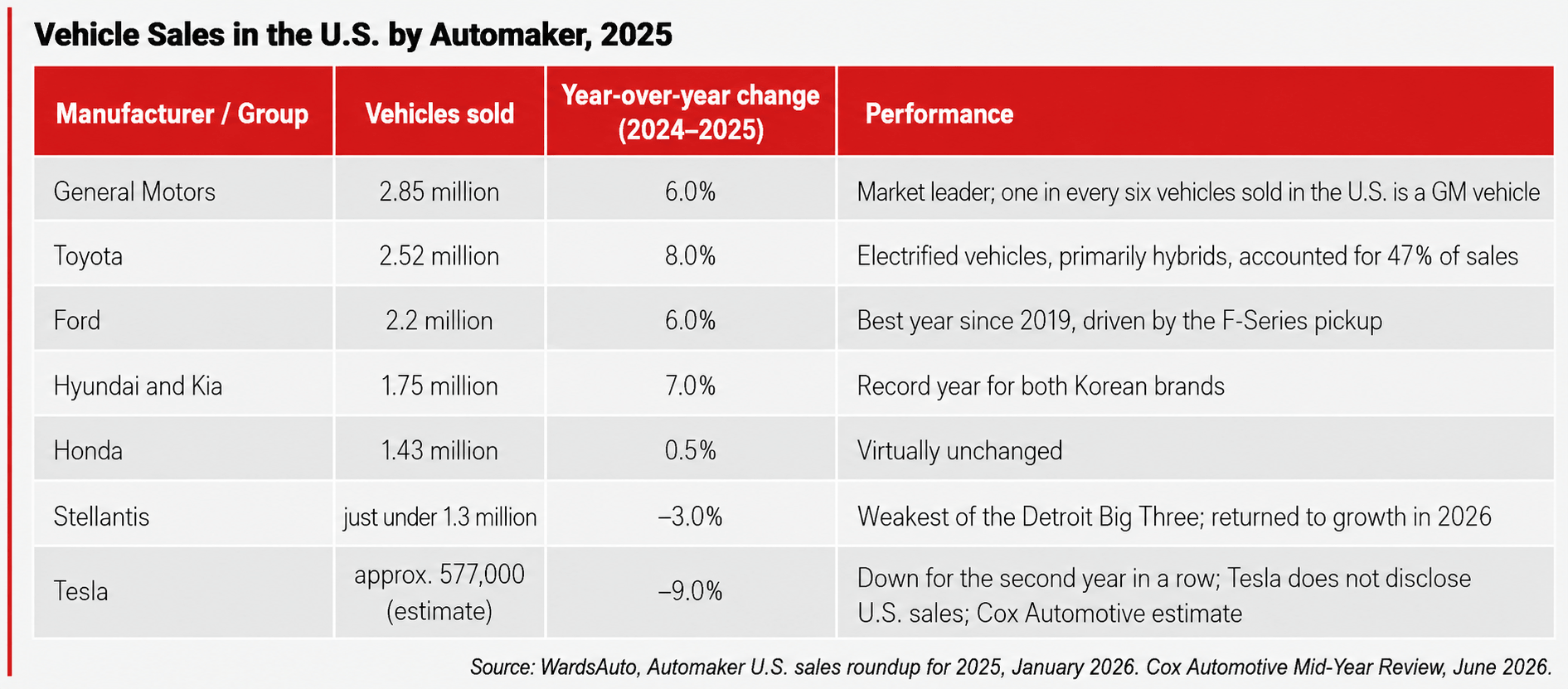
Tesla remains the largest seller of pure electric vehicles by a wide margin, but Cox Automotive (a global automotive services and technology company) estimates that its U.S. sales will fall by about 9 percent in 2025 and continue to decline in the first half of 2026. Tesla does not disclose its sales by country, so this is an analyst estimate. However, its continued dominance speaks not only to the strength of the brand, but also to the fact that traditional automakers have not yet been able to create equally compelling and significant competition in terms of volume.
Domestic production is not enough
In 2025, according to S&P Global Mobility & Alliance for Automotive Innovation, the total local production of light vehicles (the Light Trucks category, which includes sedans, hatchbacks, coupes and SUVs, as well as pickup trucks and vans) directly in factories in the United States represented approximately 10 million vehicles.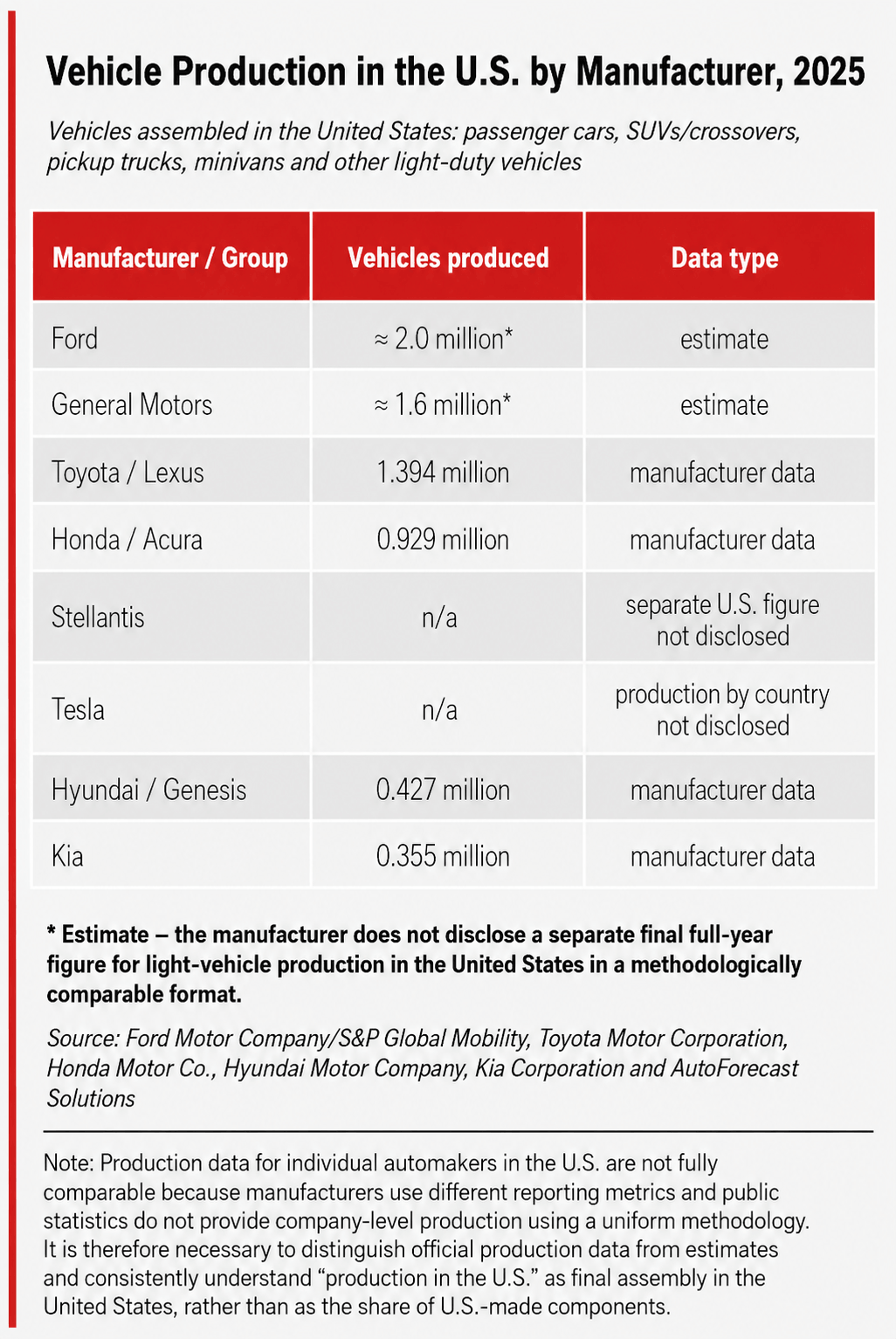
Vehicles with purely internal combustion engines maintain their absolute dominance in production. According to data from analytical agencies GlobalData and S&P Global Mobility, they accounted for more than 77 percent of the total volume. Although the production of pure electric vehicles and plug-in hybrids has grown in recent years, due to cooling demand and the abolition of federal tax breaks at the end of 2025, they represent a minority share in American production plans.
However, domestic production is not enough to meet demand. In 2025, the United States imported passenger cars worth $183.8 billion and exported them for less than $54 billion. The trade deficit in passenger cars thus reached almost $130 billion.
The largest importer by value was Mexico, with a share of 24.3 percent, followed by Japan, South Korea, Canada and Germany. The three largest suppliers – Mexico, Japan and South Korea – together accounted for 61 percent of the value of imports. It is this difference between domestic production and consumption that explains why tariffs and rules of origin have such a significant impact on the US market. The United States can support domestic assembly, but it cannot simply and quickly abandon imported cars and components.
What is an “American” car?
The debate over protecting the American auto industry often creates the impression of a battle between domestic manufacturers and foreign brands. However, the real structure of the industry is much more complex.
About half of the vehicles manufactured in the United States are produced by automakers based outside the United States. Toyota, Honda, Hyundai, Kia, Nissan, BMW, Mercedes-Benz, Volkswagen and other foreign groups operate large manufacturing plants here, employ tens of thousands of workers and have built their own supply chains around their factories. So when the US government supports or protects domestic auto manufacturing, it also protects the American plants of Japanese, German and Korean companies.
A car built in Kentucky by Toyota or in South Carolina by BMW may have a higher proportion of American labor and components than a model of a traditional American brand assembled in Mexico. The nationality of the brand therefore says less and less about the true economic origin of the vehicle.
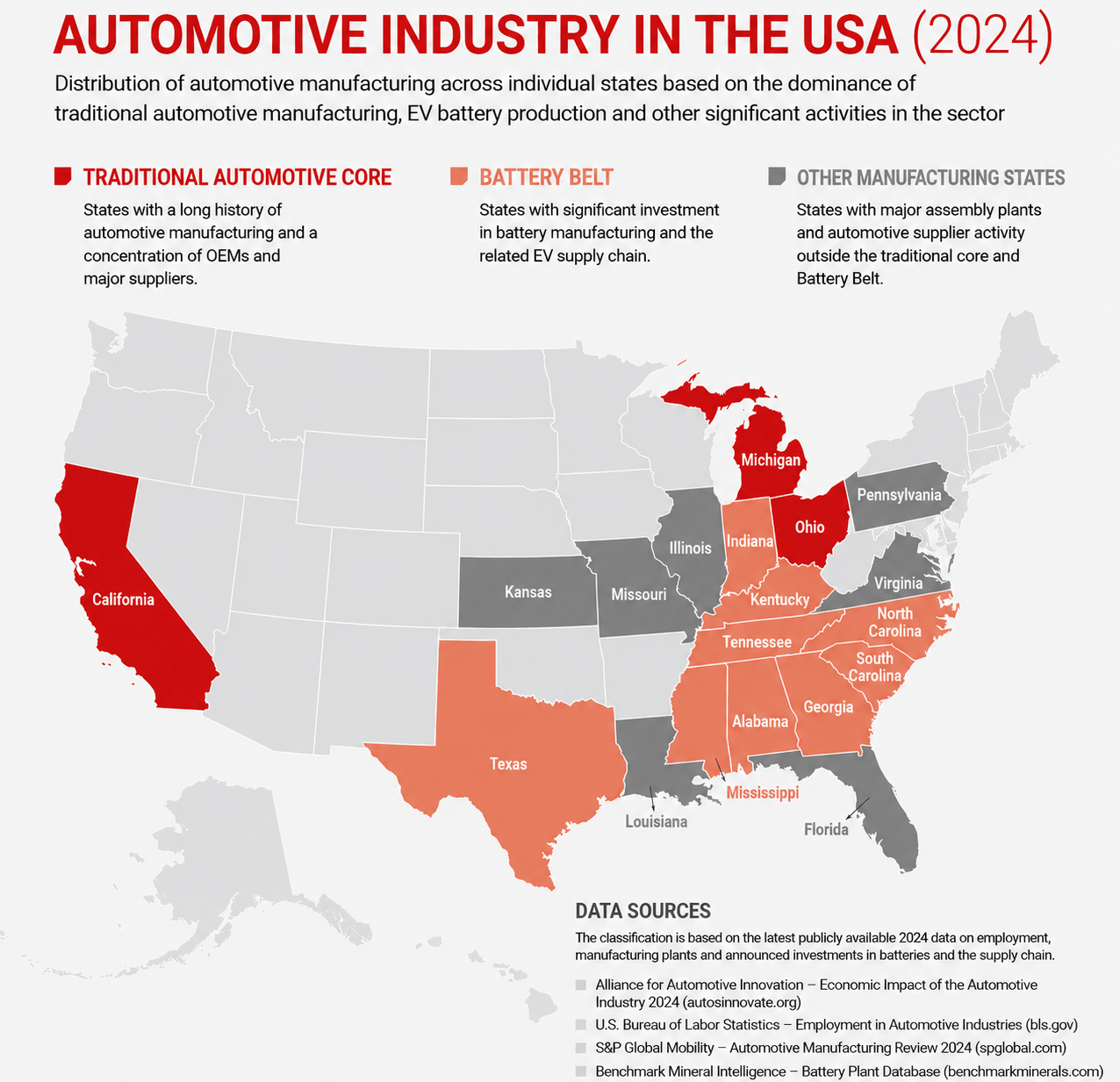
There are 55 light-vehicle manufacturing plants in the United States, operated by 20 automakers. Production is concentrated in fifteen states, mainly in Michigan, Ohio, Kentucky, Indiana, Tennessee, South Carolina, Alabama, Mississippi, Texas and California.
The state of Michigan remains the historical center. Here, the automotive industry is concentrated mainly in Detroit and the surrounding area and creates 9.2 percent of the state’s GDP. It is also of great importance in Kentucky, Tennessee, Indiana and Alabama, where it contributes five to six percent to the state economy. So it is not just a few large factories. Automotive production affects entire regional economies, their labor markets, tax revenues, infrastructure and vocational training systems.
A typical car sold in the US today is often built in three countries simultaneously. The engine may be made in the US, the transmission in Mexico, the electronics in Canada, and the final assembly will take place back in the US. It is this interconnectedness that explains why US trade policy is not only aimed at supporting domestic production, but increasingly also at strengthening the entire North American manufacturing space.
From Detroit to the Southern States
The map of American auto manufacturing has changed significantly over the past decades. While Detroit and the surrounding states of the industrial Midwest remain important centers, a significant portion of new investment has shifted to the southern United States.
Foreign manufacturers have chosen states such as Kentucky, Tennessee, Alabama, Georgia, South Carolina, and Texas for a combination of lower operating costs, weaker union representation, available land, and strong investment incentives. Transportation infrastructure, labor availability, and proximity to ports have also played an important role.
Toyota operates its largest manufacturing plant in the world in Georgetown, Kentucky, with a capacity of approximately 550,000 vehicles and 600,000 engines per year. Mercedes-Benz, Hyundai, and Honda are produced in Alabama; Nissan, Volkswagen, and General Motors are produced in Tennessee; and Toyota and Tesla are produced in Texas. BMW exports SUVs to dozens of countries from its Spartanburg, South Carolina, plant.
This development has gradually created a second major geographic axis for American automotive. While Michigan and surrounding states remain strong in development, traditional manufacturing, and supply chain industries, the South is attracting new projects and an increasing share of investment related to electromobility.
In recent years, the term Battery Belt has therefore come into use. It refers to an area primarily comprising Georgia, the Carolinas, Tennessee, Kentucky, and Alabama, where dozens of battery cell, battery material, electric drivetrain, and vehicle plants have been built or announced since 2020.
But the Battery Belt is not just a story about electric vehicles. It is creating a new industrial ecosystem that includes chemical materials, energy, recycling, electronics, logistics, construction, and industrial automation. This opens up a broader spectrum of opportunities for suppliers than the number of electric vehicles sold alone would suggest.
New investments are increasing
The investment boom in the US auto industry is not the result of a single program or administration. It is based on the confluence of several factors: market size, tariff protection, cheaper energy, federal tax incentives for production, state incentives and efforts to shorten supply chains.
Hyundai Motor Group in August 2025 increased its investment commitment for the period 2025-2028 to $26 billion. This includes a new steel mill in Louisiana with a planned annual capacity of 2.7 million tons and a robotics center. The project is associated with the creation of approximately 25 thousand jobs.
Toyota pledged up to another $10 billion over five years and subsequently announced specific investments in five plants, mainly focused on hybrid production. General Motors is investing $4 billion in operations in Michigan, Kansas and Tennessee, and Stellantis announced a $13 billion investment program. This is joined by Hyundai’s plant in Georgia, Toyota’s battery plant in North Carolina, and Volkswagen Group’s new Scout plant in South Carolina.
These investments have different technological focuses, but the common motivation is localization. Tariffs have made imports so expensive that production directly in the United States gains an economic advantage. In addition, automakers assembling cars in the United States can take advantage of partial tariff relief on imported components. They also have access to cheaper energy compared to Europe, with individual states competing with each other through tax breaks, grants, infrastructure, and support for vocational training.
“Following the slowdown in demand for electric vehicles, some investments were postponed, scaled back or adjusted for other production.”
This does not mean that all announced projects will be completed to their original extent. As demand for electric vehicles slowed, some investments were postponed, scaled back or adjusted to produce hybrids and other uses for batteries. But the direction is clear: automakers want to produce a larger share of the vehicles sold in the US in the US, or at least in North America.
It wouldn’t be possible without Mexico
Mexico is the largest foreign supplier of automobiles to the US market. It produces around four million vehicles a year and exports the majority of production to the United States. However, his role is not only in the final assembly of cheaper cars.
The North American automotive industry is built as one cross-border production system. Mexico is the largest buyer of American auto parts, and much of Mexico’s exports to the US are in the form of semi-finished products that are further processed by American companies. Before reaching the finished vehicle, individual components can cross the border between the US, Canada and Mexico more than six times during production.
The engine may contain parts cast in Mexico, machined in the United States, and then returned to Mexico for final assembly. Seats, wiring harnesses, transmissions, electronic modules and other components move between countries depending on where the specialized plants are located. Therefore, imposing a duty on each border crossing would not only burden the Mexican manufacturer, but the entire North American chain.
The free trade agreement USMCA, (United States-Mexico-Canada Agreement), which replaced the NAFTA agreement in 2020, plays a vital role. In order for a car to benefit from duty-free treatment, at least 75 percent of its value must be generated in North America. The rules are significantly stricter than under previous agreements and also include specific requirements for key components, steel, aluminum and wages for some workers.
At the mandatory six-year review on July 1, 2026, the United States refused to automatically extend the agreement in its current form for another sixteen years. The USMCA was not terminated by this and remains in effect until 2036, but will be subject to annual reviews.
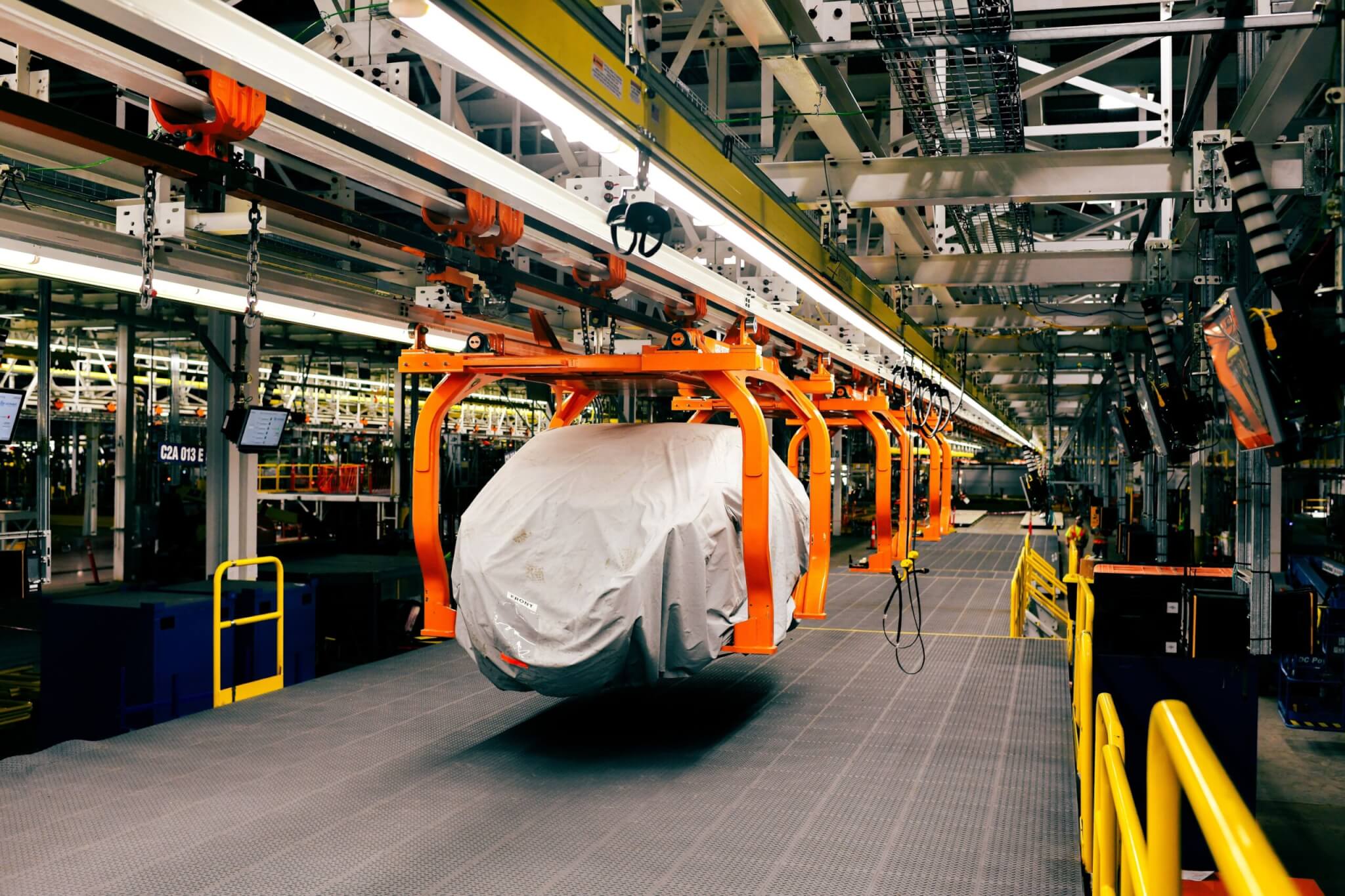
In August 2026, Ford Motor Company released a progress report on its Louisville Assembly Plant in Kentucky, where the automaker is completing a $2 billion investment to produce the new Ford Fathom affordable electric truck. | Photo: Ford
Suppliers are doing well
The transformation of the industry is also changing the relationship between automakers and their suppliers. The largest global suppliers include Bosch, Denso, ZF, Magna and Hyundai Mobis. In North America, Magna, Lear, Aptiv, Adient, BorgWarner and American Axle are particularly strong.
According to an analysis by global strategic management consulting firm Bain & Company, the average supplier margin reached approximately 6.9 percent in the fourth quarter of 2025, while the automaker margin fell to 3.6 percent. Suppliers were more profitable for the sixth consecutive quarter. After accounting for depreciation related to canceled or curtailed electric vehicle projects, the automakers’ full-year margin even fell to approximately 2.7 percent.
However, this is not a blanket success for the entire supplier sector. Manufacturers of batteries, electronics, chips, sensors and software systems have a better negotiating position. Their products are technologically complex, difficult to substitute and often essential for differentiating the resulting vehicle. Suppliers of classic mechanical components, on the other hand, are struggling with price pressure, expensive financing and uncertainty about the future production volume of combustion engines.
Autonomous driving on the move
Alongside the change in drivetrains, a less visible but perhaps even more significant transformation is underway in the area of autonomous driving. Autonomous driving has progressed further in the United States than in Europe, largely due to a more flexible regulatory environment and the ability to test new systems in individual states and cities.
Waymo, part of the Alphabet group, has made the most significant progress. By spring 2026, it was providing more than half a million fully autonomous rides per week in ten US cities. Over the course of the year, it continued to expand operations in cities such as Miami, Orlando, Nashville, Austin, Atlanta and the Bay Area. In July, it announced the start of preparations for fully autonomous operation in four more cities, namely Denver, Las Vegas, San Diego and Tampa. Waymo has thus moved from long-term testing to commercial service with real customers. It carried out approximately 15 million rides in 2025.
In addition to passenger transport, the automation of freight transport is progressing rapidly. Aurora operates autonomous trucks on routes in the southern US states and plans to expand its fleet to more than 200 driverless vehicles by the end of 2026. Aurora does not manufacture its own vehicles; as a technology company, it installs autonomous driving systems in trucks from traditional global manufacturers such as Volvo. Road freight transport is attractive to autonomous systems mainly because of the shortage of drivers, long regular routes and the ability to concentrate traffic on well-mapped highway corridors.
Tesla is also developing its own robotaxi service, but its approach is technologically different. While Waymo combines cameras, radar, lidar and detailed mapping, Tesla relies mainly on cameras and its own neural networks. This model may be cheaper and more scalable, but it also faces greater debate about safety and the degree of true autonomy.
The rapid development of robotaxi may give the impression that driverless vehicles will be the norm within a few years. The development is more likely to be uneven.
By 2030, fully autonomous services could become widespread in select U.S. cities, airports, logistics centers, and major freight corridors. But that doesn’t mean that the average customer will buy a car that can drive itself in all conditions and anywhere.
The U.S. NHTSA continues to emphasize that the most advanced systems currently available to consumers require the driver’s full attention. At the same time, it is adjusting technical regulations for vehicles that no longer need a steering wheel, pedals, or side mirrors. For example, in June 2026, it initiated a rule change that would eliminate the requirement for a manual brake pedal for vehicles designed exclusively for autonomous operation.
Regulation is gradually adapting to new technologies, but a unified federal framework is still lacking. Automakers and autonomous service operators must navigate a combination of federal safety regulations and different state rules. Therefore, pressure to create more uniform national standards is likely to increase by 2030.
The battle for the car’s brain
Autonomous driving is just the most visible manifestation of a broader change. An increasing part of the value of a car is created in its electronic architecture, chips, sensors, software and cloud infrastructure.
NVIDIA supplies computing platforms to Mercedes-Benz, Qualcomm works with General Motors and BMW, and Mobileye also maintains a significant position in assistance and camera systems. Amazon and Google provide the cloud infrastructure on which systems are developed, tested and learn from huge volumes of data.
This creates a strategic dilemma for traditional carmakers. If they want to develop software and digital architecture themselves, they must invest billions of dollars and build capabilities that have historically not been their core competencies. If they rely too much on technology companies, they may gradually lose control over data, digital services and direct customer relationships.
Carmakers are therefore looking for different models of collaboration. Some are creating their own software divisions, others are entering into partnerships with technology companies or sharing development with other manufacturers. The outcome is not yet clear. Many of the company’s own software projects have been delayed, overpriced or have had to be fundamentally redesigned.
Software is also changing the business model. Manufacturers want to sell additional functions, extended assistance systems, connectivity or subscriptions throughout the life of the car. The car should therefore not only generate revenue at the first sale, but throughout its entire life. The question remains which functions will customers actually be willing to pay for in the long term.
China: competitor, supplier and security risk
In the context of software development and protection, it is important to mention Chinese competition. Unlike Europe, Chinese automakers are practically absent from the American market. This is not a coincidence or simply the result of consumer preferences. The United States has created a combination of customs and regulatory measures that effectively makes their entry impossible.
Chinese electric cars are subject to a 100% additional tariff. After adding additional tariffs, their import is practically unrealistic economically.
The second barrier is the regulation of so-called connected vehicles, which came into effect on March 17, 2025. It prohibits the import and sale of vehicles if their key software, electronic communication systems or autonomous driving technologies originate from China or Russia, or if the manufacturer is under the control of an entity from these countries. The restrictions will apply to software and manufacturers controlled by China or Russia from the 2027 model year, and to the relevant hardware from the 2030 model year.
“Chinese cars are almost nonexistent in the American market.”
The US Department of Commerce justifies the measure by saying that a permanently connected vehicle collects sensitive data, communicates with the surrounding infrastructure and, in some cases, can remotely influence its functions. The origin of software, communication modules and automated driving systems has thus become a matter of national security.
The first clear example of the impact of regulation was the Polestar brand, which belongs to the Geely group. Although the Polestar 3 model is assembled in South Carolina, the US Bureau of Industry and Security (BIS) refused to grant it authorization to sell vehicles from the 2027 model year. The case shows that it is no longer just the place of production that matters, but also the ownership structure, control over technologies and the origin of software.
However, complete separation from China is much more difficult than the absence of Chinese brands suggests. China remains a major supplier of battery cells, graphite, materials for cathodes and anodes, precious metals and technologies for their processing. Chinese know-how also enters the North American chain through licensing, when an American or other foreign company builds a plant using Chinese technology.
The American strategy is therefore not just an attempt to displace Chinese cars. Its goal is to gradually limit Chinese influence throughout the value chain – from raw materials to battery cells and electronics to data and software. This part is likely to be one of the main regulatory topics in the coming years.
Trends to 2030
The development of the American automotive industry until the end of the decade will probably be significantly influenced by the effort to localize production. At the same time, it does not yet seem that the American market will be headed towards the dominance of a single type of drive in the coming years. Internal combustion engines, hybrids and electric vehicles will most likely exist side by side, and their representation will vary by segment, price, region and method of use of the vehicle.
At the same time, an increasing part of the value of the vehicle is shifting to electronics, software and digital functions. Therefore, we can expect continued investments by automakers in their own digital architecture, data processing, assistance systems and related services.
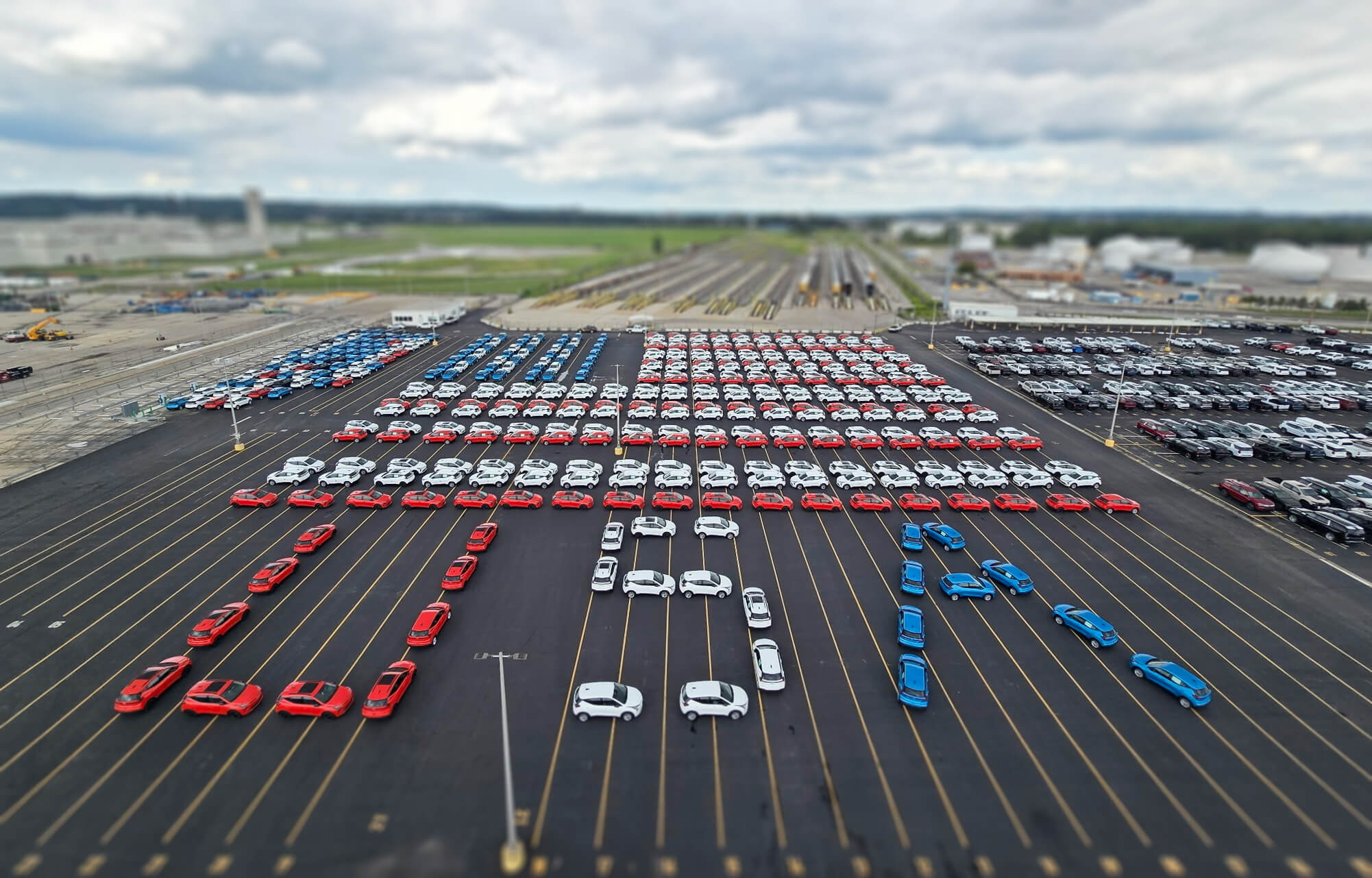
For Independence Day (July 4), employees at the General Motors plant in Kansas City created a giant American flag and the word “USA” from a total of 350 Chevrolet Bolt electric vehicles. | Photo: GM
The origin of technologies and components is likely to increasingly factor into the decisions of automakers and suppliers. In addition to price and quality, the importance of where batteries, software, chips or communication systems come from and who has access to vehicle data may grow.
Trade policy is expected to remain a significant variable. Tariffs have become a factor that companies must take into account when planning supply chains and investments, but their specific form and long-term impact may change depending on political and economic developments. Similar uncertainty is also brought about by the further development of the USMCA agreement and the rules for North American manufacturing.
Opportunity for Czech suppliers
For Czech companies, the US automotive market remains attractive primarily due to its size, volume of investments and breadth of the supplier ecosystem. At the same time, however, it will become increasingly challenging to succeed only through exports from Europe.
American customers and automakers expect rapid technical support, availability of spare parts, the ability to respond to production changes and, increasingly, the North American origin of at least part of the product. In some cases, a local sales or service representative, warehouse or cooperation with a distribution partner will suffice. However, for strategic components and large programs, in-house production or a partnership with a local supplier may be necessary.
Plant expansion creates demand for machine tools, production lines, robotics, quality control, metrology, energy solutions, logistics, maintenance and operational safety. The Battery Belt needs not only cell manufacturers, but also suppliers of chemical equipment, clean rooms, filtration, cooling, handling and recycling.
Czech companies can benefit from a long tradition of precision engineering and the ability to deliver custom solutions. However, they will need to better explain their added value, work with local certifications, and accept the fact that the American customer assesses financial stability, production capacity, legal risks, and long-term ability to support the project directly in the market, in addition to technical parameters.
Contact
Next articles and interviews
Next articles and interviews
+ Show