

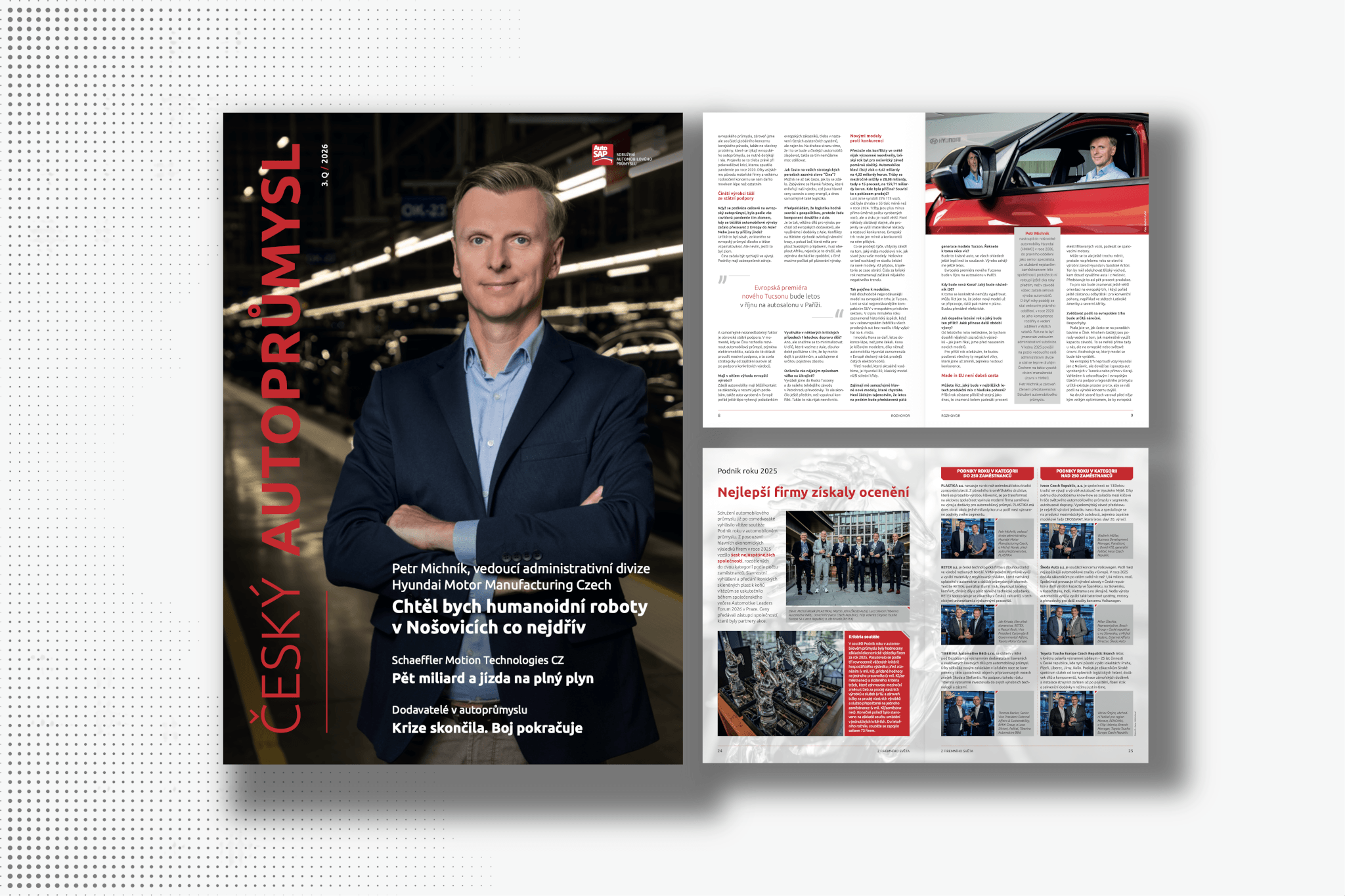
Summer edition of the Czech Automotive Industry magazine

15/6/2026 |Articles are machine translated

There was a time when changes in industry were measured in decades. New technology took years to get from the development center to production, and years more to impact the market. Today, the pace of change has shrunk to months, sometimes weeks. This is true in the automotive industry more than anywhere else. In fact, we felt it while preparing this issue. By the time we finished the magazine and sent it to the printer, some topics had acquired new context and more information had emerged confirming that the greatest competitive advantage today is the ability to react quickly.


This also applies to the area that we have devoted significant space to in this issue – automated driving. Car manufacturers have calculated how much investment they still have to make so that their vehicles can drive completely autonomously and they can take responsibility for their operation without any worries. In conjunction with the real interest of customers, this has resulted in a “transitional phase” in the form of the L2+ driving level. Tesla brought it to Europe and the Netherlands was the first to allow it. In recent days, Lithuania has also joined the list of countries that allow fully automated driving with supervision. This is also an addition to the texts inside the magazine. Edgar Martinez, the head of development at the Prague-based Valeo company, confirms in an interview with Český autoprůmysl that the development related to the L2+ driving level is now a strategic priority for many car manufacturers and their suppliers.

Automated driving is also one of the areas that German car manufacturers are addressing. However, it is not what worries them the most. As our external collaborator Václav Lavička writes in a large overview of the German automotive industry, “the groups are betting on new strategies, models and new bosses, but they still lack a clear plan for overcoming their own crisis.”

Interestingly, many car manufacturers, which are under pressure from Chinese manufacturers, no longer see Chinese companies primarily as competitors or essential suppliers. While we were preparing this issue, more news came in about new partnerships between European car manufacturers and Chinese companies, about sharing factories or joint development of technologies. Just a few years ago, such steps would have caused surprise. Today, they are gradually becoming a normal part of the transformation of the automotive industry.

And finally, I kept the key material of this issue – an interview with the still somewhat new rector of the Czech Technical University, Michal Pěchouček. Unlike the automotive industry, where everything is constantly accelerating, the “boss” of the Czech Technical University speaks of the transformation of the university as if it were the construction of a cathedral. About a patient transformation into an institution that will cooperate with industry and co-determine technical progress. However, the prerequisite is that business and the university are able to clearly state how they can benefit each other – and this is still not entirely successful today.

Michal Pěchouček’s goal is to get CTU among the hundred best technical universities in the world. And if Europe is to survive in the era of technological acceleration, the connection of top research, universities and industry will be one of the key prerequisites for it not only to catch up with the changes.

We wish you inspiring reading until the summer days.


to read

HERE

Contact

Ing. Tomáš Jungwirth

Communications Manager

jungwirth@autosap.cz
Ing. Libuše Bautzová

Editor-in-Chief of the Český autoprůmysl magazine

bautzova@autosap.cz

Next news

Next news

+ Show