Hungary has become one of the important centers of the European automotive industry over the past ten to fifteen years, mainly thanks to German manufacturers. In addition to the car factories themselves, battery factories have been built or are still being built in the country by the Koreans and, more recently, mainly by the Chinese. The government of Prime Minister Viktor Orbán supports the ambitious plans of foreign investors, which is especially evident in its relationship with China. Budapest’s foreign policy towards Beijing is much more accommodating than the approach of most other EU member states.
The automotive industry in Hungary directly employs around 150,000 people and, together with related sectors, creates almost a fifth of the value of total industrial production. Its weight in the economy is already higher than in Germany, where there are growing concerns about so-called deindustrialization, i.e. the weakening and decline of industry. Hungary has been experiencing the exact opposite process for many years – in some regions, such as Debrecen in eastern Hungary, it has been rapid, which sometimes provokes resentment or outright resistance from the local population.
“German and other foreign investors clearly do not mind the authoritarian style of government of Prime Minister Viktor Orbán, who has been in power since May 2010, otherwise they would not have become so involved in the country with 9.6 million inhabitants,” noted the German newspaper die Welt.
According to Adrian Stadnický of the Eastern Committee of the German Economy (OA, an interest group that promotes economic relations between Germany and Eastern European countries), Hungary is not only attractive to foreign investors due to government subsidies and lower labor costs, but also because its public administration works efficiently and has been cooperating well with investors for many years. Hungary has a sophisticated “automotive ecosystem” involving close ties between end manufacturers, suppliers and universities.
“Investors appreciate subsidies and well-functioning public administration.”
The automotive industry includes over 700 companies, including nine major international concerns, and around 70 key suppliers.
Strong German Trio
The Hungarian Investment Promotion Agency (HIPA, a government agency under the Ministry of Foreign Affairs) emphasizes on its website that Hungary is the only European country outside of Germany where three premium brand manufacturers are present: Audi (Györ), Mercedes-Benz (Kecskemét) and BMW (Debrecín).
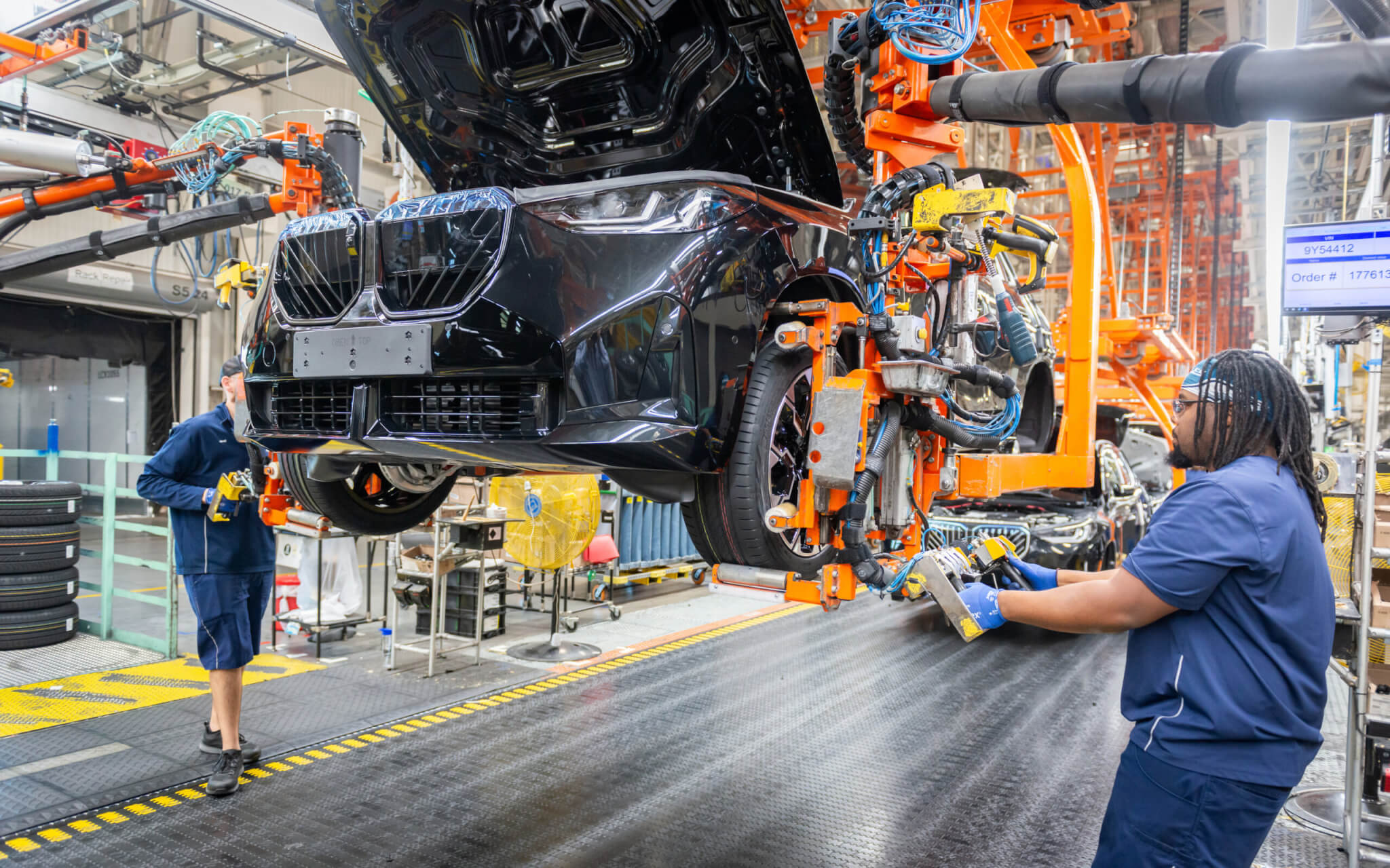
BMW completed its latest production plant in Debrecen, eastern Hungary, at the beginning of November. It will produce only fully electric cars. The investment of around two billion euros was also supported by the Budapest government. The target annual production capacity is 140,000 cars.
The commissioning of the assembly line represents an important step towards the series production of the new fully electric SUV, designated as the iX3. As the German magazine Automobilwoche pointed out, this is the first model of the so-called Neue Klasse, on which the Munich carmaker is counting on for its further sales expansion.
In Hungary, which last year overtook Italy in passenger car production and ranks eighth in the European ranking (excluding Russia), another important center of automobile production has emerged.
One of the oldest and largest is Györ (Ráb) in western Hungary, where Audi Hungária has invested 12.9 billion euros since its founding in 1993, making it the largest investor in the Hungarian automotive industry. Last year, Györ produced almost 1.6 million power units and 179,710 cars, including disassembled SKD sets. Over the past year, it has invested another 340 million euros, the largest part in the preparation of the new electric drive (MEBeco) and in the new generation of the Audi Q3 model.

The Audi factory in Györ is the largest investment in the Hungarian automotive industry to date. | Photo: Audi Györ
Mercedes-Benz, which began production in Kecskemét, south of Budapest, in 2012, also plans to significantly expand production. The A-class luxury cars, the CLA Coupé and CLA Shooting Brake (Mercedes’ smallest station wagon), as well as all electric EQB models are leaving the lines there. All drive systems are used – combustion engines, hybrids and purely battery-powered. The company, with approximately 4,500 employees, is one of the largest employers in the region.
The Kecskemét factory is to be a “factory of the future”, just like the one in Debrecen for competitor BMW. Mercedes-Benz is testing the deployment of humanoid robots there, which should later find application in Germany as well. The automaker has also allocated around a billion euros for the construction of a second hall, which will allow it to roughly double production in Kecskemét to 300 to 400 thousand vehicles per year, said the automaker’s production manager Jörg Burzer in an interview with Automobilwoche magazine at the beginning of October.
At the beginning there were Japanese and Americans
In connection with the rapid rise of the Hungarian automotive industry and the ambitious plans that foreign investors have put forward there with the support of the Orbán government, it is sometimes, with some exaggeration, spoken of as an “automobile miracle”.
The impetus for this was given by the Japanese company Suzuki, which opened its factory on a green field in Esztergom in 1991 shortly after the fall of the Berlin Wall. Since then, the Japanese have invested around two billion euros there. The factory, which employs 3,200 people, is now undergoing modernization at a cost of more than 24 million euros, a fifth of which was provided in the form of a subsidy by the Hungarian government. Suzuki also manages its European-wide logistics from Hungary.
“Hungary ranks eighth in Europe in passenger car production.”
Japan’s Suzuki still holds the top spot on the Hungarian new car market, mainly thanks to the Vitara and Suzuki S-Cross models. Toyota is in second place, while Skoda is in third, with the Octavia being the best-selling model after the Suzuki Vitara and Suzuki S-Cross.
Shortly after the fall of the Berlin Wall, a joint venture between the American General Motors and the Hungarian Rába engineering works began operations in Szentgotthárd in the southwest of the country, close to the Austrian border. In 1992, it took over the assembly of the Astra Classic models and also the production of small engines. General Motors, which became a 100% owner in 1995, gradually increased the engine plant’s production capacity. However, the Americans sold their chronically loss-making European division in 2017, and the German Opel brand found itself in the hands of the French PSA Group. It then merged with Fiat Chrysler Automobiles in the Stellantis group in early 2021. Its Opel Szentgotthárd plant now produces three- and four-cylinder combustion engines used by several of the group’s brands. Stellantis allocated more than 100 million euros last year to transform this factory, which will focus on the production of important components for fully electric cars in the near future.
BYD is limiting plans, it has no people
 The Chinese also see opportunities in Hungary, specifically the company BYD (Build Your Dreams), which established its first European factory in this country about eight years ago. Its company Electric Bus & Truck Hungary has been producing electric commercial vehicles and buses in the city of Komárom, right on the border with Slovakia, since 2017. BYD, the world’s largest manufacturer of electric cars, intends to invest 32 billion forints (approximately 80 million euros) in the construction of a new hall in Komárom, so that the total capacity will triple to 1,250 electric buses and electric trucks per year.
However, the key investment of the aforementioned Chinese concern is the construction of a car factory in Szeged in southeastern Hungary. The company said last year that the Dolphin and Atto 3 compact SUVs, which are currently imported to Europe from China, would be leaving the Szeged production lines. BYD was originally scheduled to start production in Szeged at the end of this year, but due to delays caused by, among other things, a shortage of workers, it will be sometime in 2026, and even on a smaller scale than was planned for the first two years of operation, Reuters recently reported.
The initial production capacity of the Szeged factory was set at 150,000 cars per year and is expected to increase to 300,000 in the future. However, the agency reports that BYD, which has invested around four billion euros in Szeged so far, will produce only a few tens of thousands of cars there next year, a fraction of the planned initial capacity. Production will increase in 2027, but will still remain below the planned level. BYD did not comment on the information.
Its plans for further expansion in Europe do not fundamentally change, according to the cited source. A new factory with a capacity of around 150,000 cars per year, which the Chinese automaker is counting on in Turkey, is to be in reserve.
“China’s foreign direct investment in Hungary in 2024 amounted to 3.1 billion euros.”
The Chinese carmaker BYD is also considering setting up a European centre in Hungary, which would be responsible for managing sales and after-sales service for customers, and developing and testing new models for the European market. The head of the group, Wang Chuan-fu, discussed this in Budapest with Prime Minister Viktor Orbán in May this year. This could create around 2,000 new jobs. This was announced in early July by Minister of Foreign Affairs and Trade Péter Szijjártó, who said that the Hungarian-Chinese partnership has “strategic value”. “We see cooperation between the West and the East not as a threat, but rather as an opportunity,” the minister added at the time. According to him, the government in Budapest will support the new project with a grant of 3.1 billion forints (7.8 million euros).
Hungary as a center of the battery industry
The construction of new EV production capacities goes hand in hand with plans for battery factories. The government in Budapest has set itself the goal of making Hungary one of the hubs of the battery industry not only in Europe but also in the world. That is why it supports the construction of the relevant capacities. In September 2023, the Minister of National Economy Márton Nagy announced that the government plans to build battery factories with a total capacity of 250 gigawatt hours per year over the next few years. According to him, this would cover 35 percent of European needs and would make Hungary the fourth largest battery manufacturer in the world after China, the USA and Germany.
The largest battery factory in Hungary is being built by the Chinese concern CATL (Contemporary Amperex Technology Co. limited) in the Southern Industrial Park near Debrecen. It is an investment worth 7.3 billion euros with a target capacity of around 100 gigawatt hours. This is CATL’s second gigafactory in Europe, the first one is already in production in Arnstadt (Thuringia) in eastern Germany and is further expanding its capacity. CATL’s battery factory in Debrecen will be its largest outside of China, its director Shen Feng emphasized at a press conference in Budapest in November.
CATL currently employs around 500 people in Debrecen, and by the end of this year, the number should be around 2,000. However, the investor admits that it is not managing to hire the necessary number of Hungarian workers and is trying to fill this gap by importing workers from China and the Philippines.
The Chinese EVE Power is also building a battery factory near Debrecen, investing around 1.2 billion euros. It plans to put it into operation next year.
The Koreans started producing batteries in Hungary before the Chinese. Samsung SDI in Göd, located about 30 kilometers north of Budapest, has been supplying batteries and their components for many years. The Koreans rebuilt the original plant there in 2017, which produced plasma screens, and plan to invest another 337 billion South Korean won (approximately 190 million euros) to increase production capacity there.
The Hungarian Göd is Samsung SDI’s main production capacity in Europe, supplying batteries to Hyundai and Kia cars manufactured in the Czech Republic and Slovakia. The first construction phase (rebuilding the original factory) was followed by the second phase, which, when completed in 2022, will increase capacity to approximately 40 gigawatt hours per year. Now, the third phase should come, the BusinessKorea server reported at the end of May.
However, the Koreans have encountered a complication. At the end of October, after an almost two-year dispute, a court in Budapest ruled in favor of local environmental groups and revoked Samsung SDI’s operating permit – citing “procedural errors” during its granting. The factory will therefore have to suspend production until it obtains a new permit, dailynewshungary.hu reported.
However, changes are coming to the Hungarian battery industry, and this is precisely at the expense of the established Koreans. Their two key factories, Samsung SDI in Göd and SK Innovation in Komárom, have so far had to lay off over 1,500 people. Samsung itself employed 694 fewer workers in the country in April this year than about a year ago, while SK Innovation cut 853 jobs. According to telex.hu, South Korean manufacturers are “losing ground in Hungary” under the pressure of rapidly expanding Chinese competition (CATL, EVE Energy, or Sunwoda). And this trend, which is also spreading globally, is felt not only by South Korean battery manufacturers themselves, but also by their suppliers.
The largest recipient of Chinese FDI in Europe
Chinese companies have chosen Hungary as a base for their expansion in Europe. Not so much because of its advantageous geographical location and experience in the production of cars and automotive components, but because the Orbán government’s policy towards China and the entire East is much more accommodating than the approach of most other European Union member states, noted the German magazine Automobilwoche.
Last year, the country became the largest recipient of foreign direct investment from China in Europe for the second year in a row, mainly thanks to large-scale projects in electromobility. Last year, investments amounted to 3.1 billion euros compared to 1.8 billion in 2023. Overall, the “big three” (Britain, Germany and France) have so far received the most Chinese capital in Europe, but their importance has declined as a result of recent transfers of Chinese FDI to Hungary. Between 2019 and 2023, 52 percent of Chinese investments ended up in the aforementioned three countries, according to the Berlin-based Institute for China Research (MERICS), while last year only a fifth and in Hungary almost a third (32 percent).
The boom in the automotive industry in Hungary, including the construction of battery factories, is undoubtedly beneficial for the economy. However, at the local level, it often encounters resistance or disagreement from residents, not least because of the adverse impacts on their living conditions in the form of increased traffic congestion or noise.
One example of how investments strongly affect the lives of residents in specific places is the 5,000-person village of Algyő near Szeged. As reported by the Hungarian media, its mayor Áron Molnár “after consultation with the local population” signed an agreement with the BYd car company, according to which around 350 Chinese workers will move to the village, as local labor resources are exhausted. According to him, the Chinese will be accommodated in the Jura Industrial Park for one year under strict conditions. For example, they will have their own food and beverage store, and a security service will operate in the area.
The village reserved the right to terminate the agreement early without any sanctions “in the event of negative experiences”.
Contact
Next articles and interviews
Next articles and interviews
+ Show